From its official beginning on November 11, 1926, through the heyday of auto travel in the 1950s and '60s, Route 66 was explored by families, vagabonds, dreamers and untold others, fueling thousands of restaurants, hotels, motels and tourist attractions along the way.
Route 66 can no longer be found on most regular highway maps. And yet it is still very active and vibrant. The mom, pop and apple pie restaurants are still there. The culture created by the automobile is alive and well. Original motels, gas stations, and scenic byways were fun to find and visit.
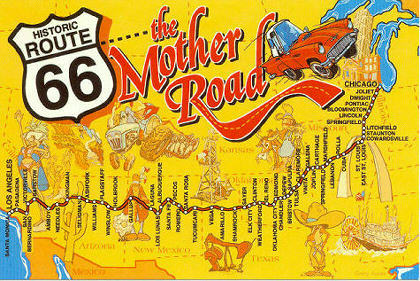
Route 66 stretches from Chicago, IL. to Santa Monica, CA. Some 2400 miles cruises through eight states and three time zones, influencing lifestyles and spawning a culture that earned it the nicknames of "Main Street of America" and "The Mother Road." We rode 2726 miles with about 90% being on the old road, some dating to the 20s.
Route 66, when created in 1926 it was a hodgepodge of paved roads linked with gravel sections and even wood plank sections. It really came into it’s own, after World War II, when more people had cars and the road was much improved.
During the Great Depression of the 1930s, it became the road to a new beginnings for many down-on-their-luck farm families who abandoned drought-ravaged homes and headed west in search of a better life. Their plight was made famous by John Steinbeck’s novel (and later, the motion picture) “The Grapes of Wrath.” The intrigue and allure of The Mother Road inspired dozens of other books, songs and even a television series.
What, is this endless fascination that people have with Route 66? Why are people still out there, looking for what’s left of it, even through the road officially ceased to exist years ago? What is it that brings them to the small towns along the old road? Maybe it’s because Route 66 brings to mind a happier time, a simpler time - a time when road travel was truly an experience. Every town was different and you actually drove through them! Most of the tourist courts and restaurants were mom and pop operations - and often that’s who took care of you when you stopped for the night or for a bit.
Bobby Troup, a likeable young man from Pennsylvania, listened to the rhythm of the road. Bound for what he hoped would be a lucrative West Coast music career, he left Harrisburg in his green ‘41 Buick convertible in the simmer of ‘46. Slipping onto Route 66 in Chicago, he arrived in Los Angeles 10 days later with a new song that caught the ear of Nat King Cole, who quickly turned it into a hit that became the anthem of the asphalt. In case you don’t know the words to “Get Your Kicks on Route 66" here they are.
“If you ever plan to motor west . travel my way . take the hiway that’s the best . get your kicks on Route 66 ... it winds from Chicago to LA .... more than two thousand miles all the way ... get your kicks on Route 66" ... now you go through St. Looey ... Jopin . Missouri ... and Oklahoma City looks mighty pretty ... now you’ll see Amarillo ... Gallup . New Mexico ... Flagstaff , Arizona ... don’t forget Winona ... Kingman . Barstow . San Bernardino ... now won’t you get hip to this timely trip ... when you make that California trip “get your kicks on Route 66.”
Fast food was the fare of the Route 66 drive-in restaurants along the way. Burgers and fries became inseparable. Along the highway were billboards and the famous Burma-Shave signs. Route 66 enjoyed a pop-cultural homage of sorts when young actors Martin Milner (Tod) and George Maharis (Buz) jumped into a beige ‘59 Corvette and drove the glorious highway into America’s baby-boomer living rooms every Friday night on television from 1960 to 1964, the show was named “Route 66.”. Route 66 has been paved since 1937.
These photographs were referenced by Tom’s original page but were absent from the WordPress reconstruction. They have now been restored to this chapter.