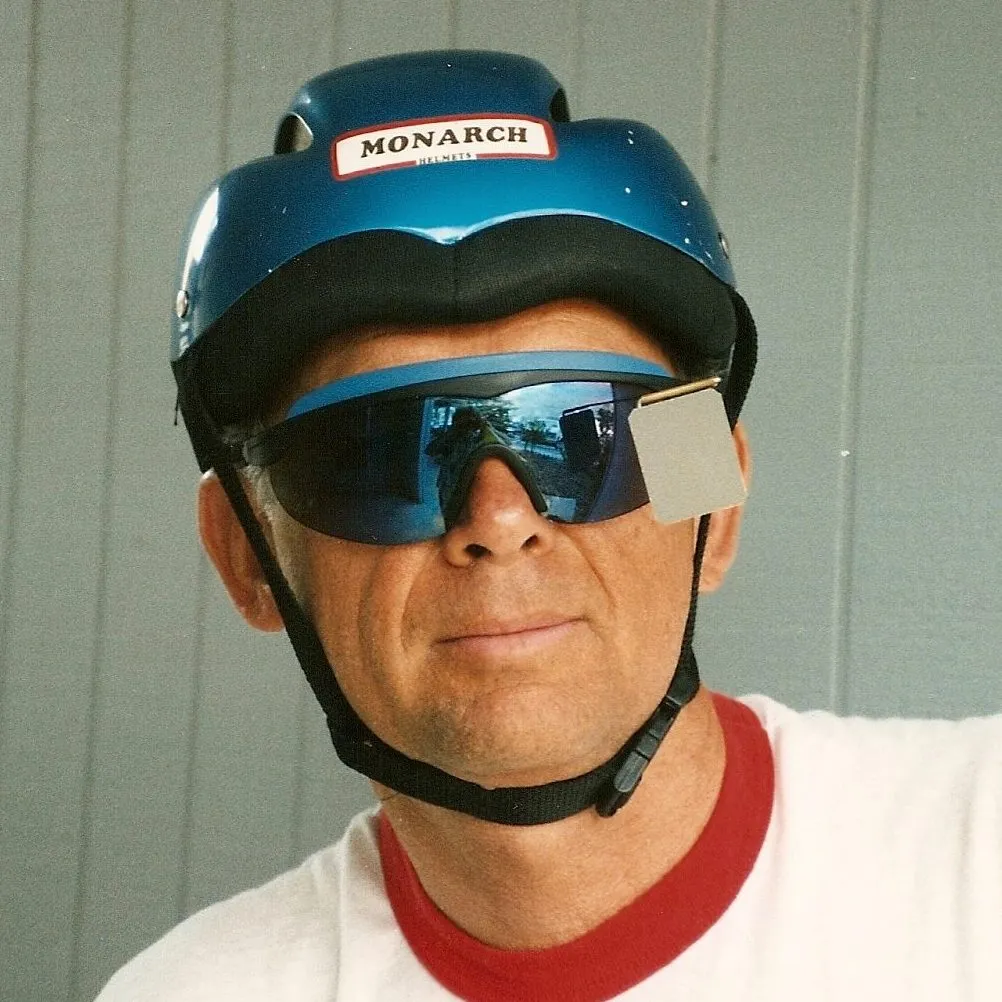
July 6: We left Anchorage on a great day, it was just beautify. This is touring at it’s best. The road was great and we even had a trail-wind. All day we rode along side the “Turnagain Arm.” Have I said “life is good.” There were even some bike paths along the way. We would find a bike path ride it to it’s end and then get back on the highway. We met a guy who was coming from someplace and going to someplace. This guy was not sure just what he was doing. We said our goodbyes and rode on (we will run into him again).
Our overnight was in the town of Girdwood (population 1,935). This town use to be right on the shores of the Turnagain Arm but after the big earthquake, which destroyed must of the town it was rebuild higher up the valley. So up the hill we rode, looking for the hostel. It’s been a perfect day so it was not much of a surprise to us that the hostel was located a mile or so off the main road on a dirt road. This was a little more that just a dirt road. There are several new homes being built along this road and there were some big trucks hauling supplies in to the sites. Of course the trucks kicked a whole lot of dust. But even worse was the guy who lived on the road and had his hose running water on the road to keep down the dust. Now, he was not just keeping down the dust but he was making the worse mud puddles of the trip.
We found the hostel, checked in, and headed out to look around. This area is famous for the “Alyeska Resort,” Alaska’s premier resort and conference center. The resort includes “The Alyeska Prince Hotel.” We took a look at this very up-scale hotel, it was magnificent. In the parking lot we noticed two van’s that had a lot of bikes on top. Going over we saw they were from “Back Roads,” a bike touring company. Boy, these guys/gals are really staying in a first class place (of course they are paying for it).
Turnagain Arm: “Turn Again Captain.” There’s a statue in Anchorage honoring Captain Cook, the famous Pacific explorer who discovered this area. The Captain was trying to find a northern passage. When a river failed to materialize any hope and he had to “turn-again” thus giving the arm it’s unusual name - Turnagain Arm.
Girdwood: The town was named after Col. James Girdwood, who established a mining operation near here in 1901. Attend the “Forest Fair,” a popular summer crafts fair held in July. Stop for a snack at “The Bake Shop.” Have a great burger at the “Chair 5" restaurant (also famous for having over 30 single malts and 60 micro brews.
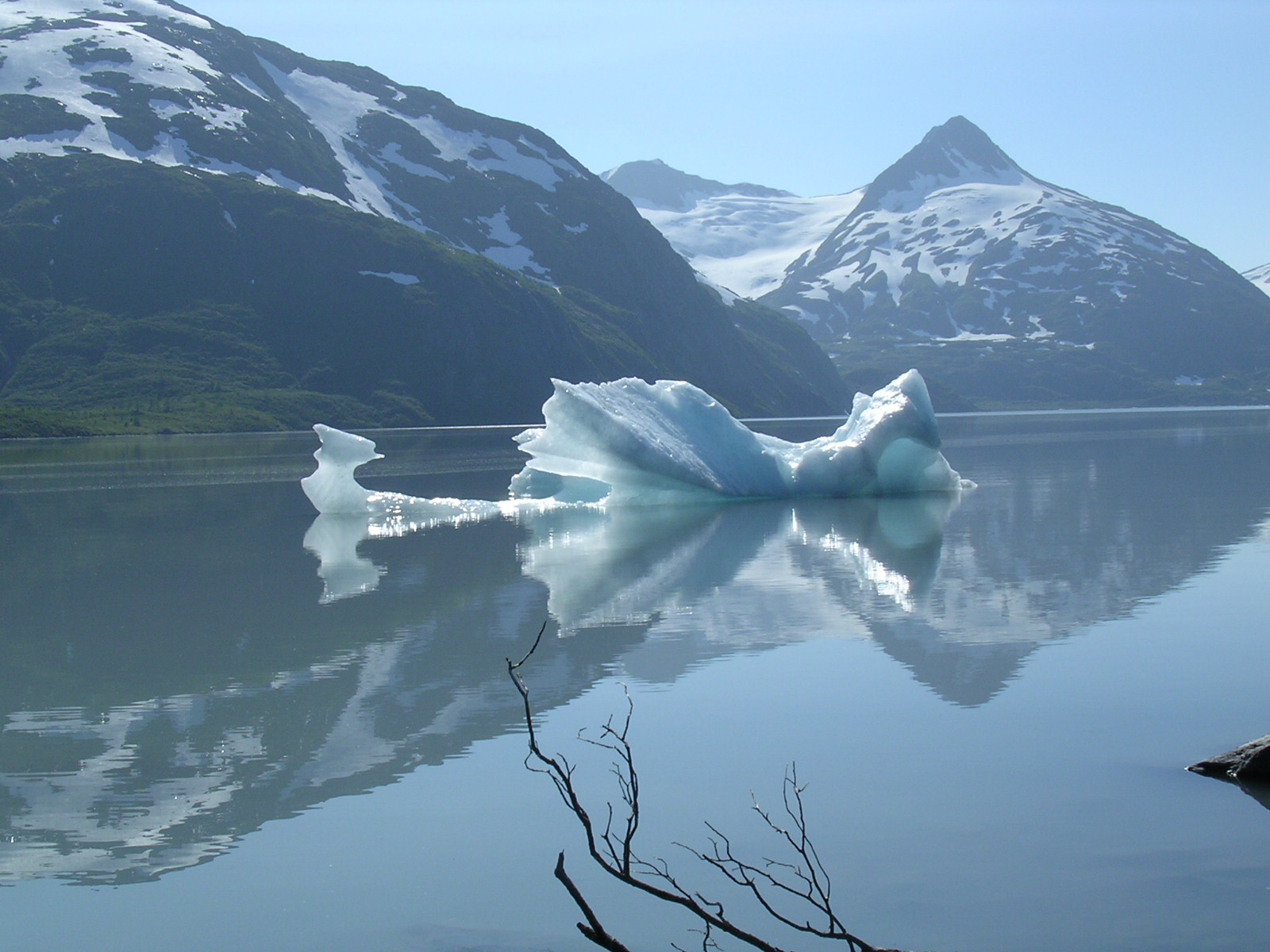
July 7: Today we would make our longest side trip in miles of any of our tours. Others, that we have met, told us, if we get a chance, to be sure to see the town of “Hope.” This would mean a 17 mile side trip to the town(and 17 miles back out) so we decided to made it our overnight. But first we took another side trip up the Portage Valley to take a look at the Portage Glacier. On past tours we did not do much side tripping but here in Alaska it just seemed the thing to do, and we were very glad we did.
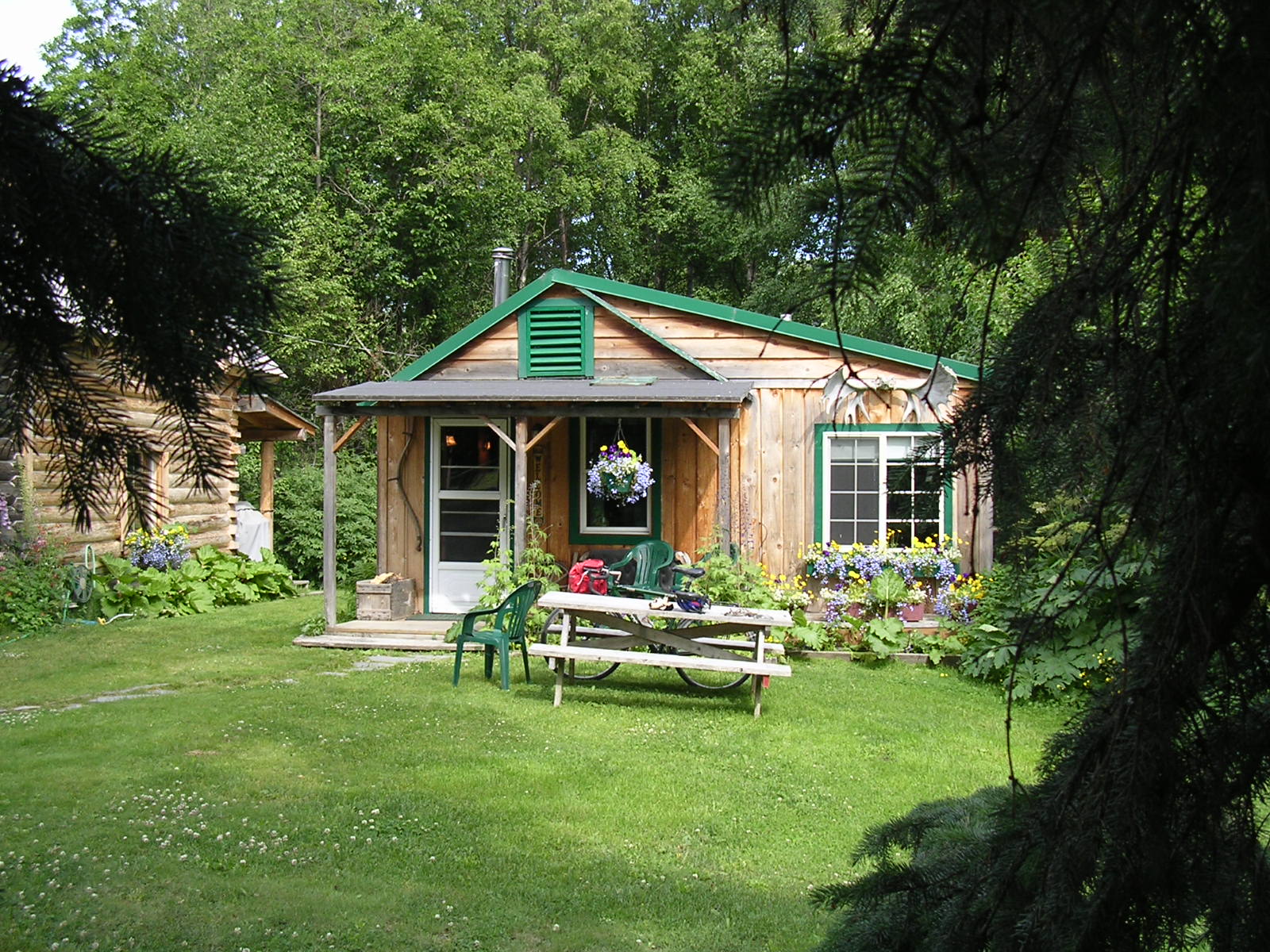
The road “DOWN” to Hope (population 130) was so rough it was hard to get up any speed. This being a very small town, but a big tourist attraction, there were many places to stay. In the town it’s self there were only B&B;’s. We found a very nice one, named, “Hope Gold Rush B&B.;” As you can tell from the picture below our cabin was very nice. By the way all the streets (there are only about 8) in Hope are dirt, mostly hard packed. Hope is located near the end of the road at the mouth of Resurrection Creek on Turnagain Arm.
Hope was a gold rush town before Dawson or Nome. In 1889, a man named King discovered gold in Resurrection Creek. More prospectors rushed to stake claims. On a lark, the community of tents and cabins that grew at the mouth of the creek decided to chose the name themselves, after the youngest rusher to step off the next boat. His name was Percy Hope. Hope and the surrounding area had 3,000 people long before Anchorage existed. Gold was plentiful. Robert Mathison panned 385 ounces in less than 2 months. However, the boom faded as quickly as it had started. The population dropped to a mere 23 and is now close to 130.
July 8: We woke to another wonderful day. The second “B” in “B&B;” was great too. Now we had a 17 miles “UP” hill to get back on the main highway. On the good side was once we reach the main highway and climbed a little more we than had a long downhill to the town of Seward. We made a stop for lunch at the “Summit Lake Lodge.” I highly recommend this stop, as it has genuine hospitality, located on the north shore of Summit Lake in Alaska’s most beautiful log lodge.
On we rode looking forward to “Moose Pass” (population 118). Wondering just how high we would have to climb on this pass. We were thrilled to find there was NO pass. The name, Moose Pass, came from a 1904 observation by Nate White of the first moose recorded in this area. But, as usual in this neck of the woods there is another version. In 1903, a mail carrier driving a team of dogs had considerable trouble gaining the right-of-way from a giant moose. A post office was established in 1928 and the first post-mistress officially named the town Moose Pass. Take our pick. We stopped for a snack at “Estes Brothers Groceries and Water-Wheel.” The historic waterwheel is a duplicate of the one Ed Estes’ stepfather built for him in 1928, so the big wheel keeps a-turnin. A sign above the door reads “if you have an ax to grind, do it here.”
Traffic was on the heavy side into Seward (population 3,010) as it is very popular with tourist. Fishing is the greatest, especially for halibut and salmon. As usual we found the Hostel, checked in and then headed out to explore the town. As we rode along the shoreline it was packed with RV’s. I have never seen so many. They were from all over the USA.
The town was established in 1903 by railroad surveyors as an ocean terminal and supply center. The Iditarod Trail was surveyed in 1910 as a mail route between Seward and Nome. It was used until 1924, when it was replaced by the airplane. The 938-mile-long-trail-now a National Historic Trail - is probably best known for the Iditarod Trail Sled Dog Race that is run each March between Anchorage and Nome, but the trail starts in Seward.
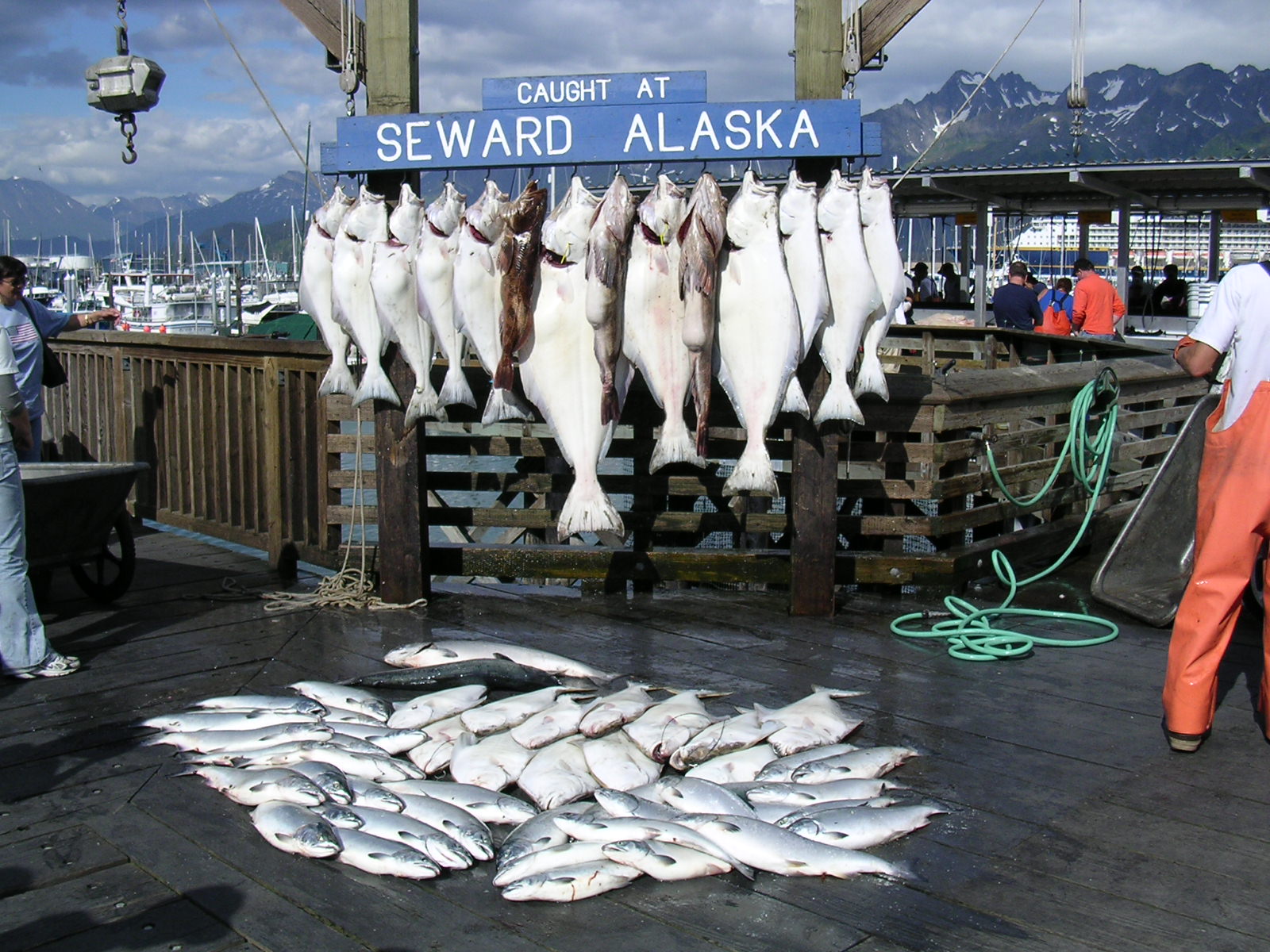
Seward - Of course go fishing. See the Exit Glacier and even hike on it. Take a glacier cruise. Go for a dog sled ride. Hike to the top of Mount Malathion (3,022 feet) or if you are there on July 4th join the race to the top and back down. Men’s record = 43 minutes, Women’s record = 56 minutes. Visit the Seward Museum. Stop by the Alaska SeaLife Center. Go shopping.
Special Note: The Alaska State flag was designed by a boy from Seward, Bobby Benson. Territorial Gov. George Parks conducted a flag-designing contest in 1926 and called upon Alaska school children to submit designs for an official Alaska flag. There were 142 designs submitted, the committee unanimously selected the design by Bobby. Bobby explained the design of the flag: The blue field is for the Alaska sky and the forget-me-not, an Alaska flower (now the official state flower). The North Star is the future state of Alaska, the most northerly of the union. The Big Dipper is for the Great Bear, symbolizing strength.
Another Note: “Sourdough” - Anyone who’s lived here at least one winter. The term originated from “an old-timer who is sour on the country but doesn’t have enough dough to leave.” We run into a lot of “Sourdoughs.” Most were either motel owners or Restaurant owner’s. There business is in the dumps due to the current tourist traveler does not use their places of business. Today, most tourist travel by RV or by Cruse Ship. The eat and sleep on board. You would then think that guys on bikes would have been greeted with open-arms. Sometimes we were other times we were not. Many of the places have been up for sale for years, one for over 11 years.
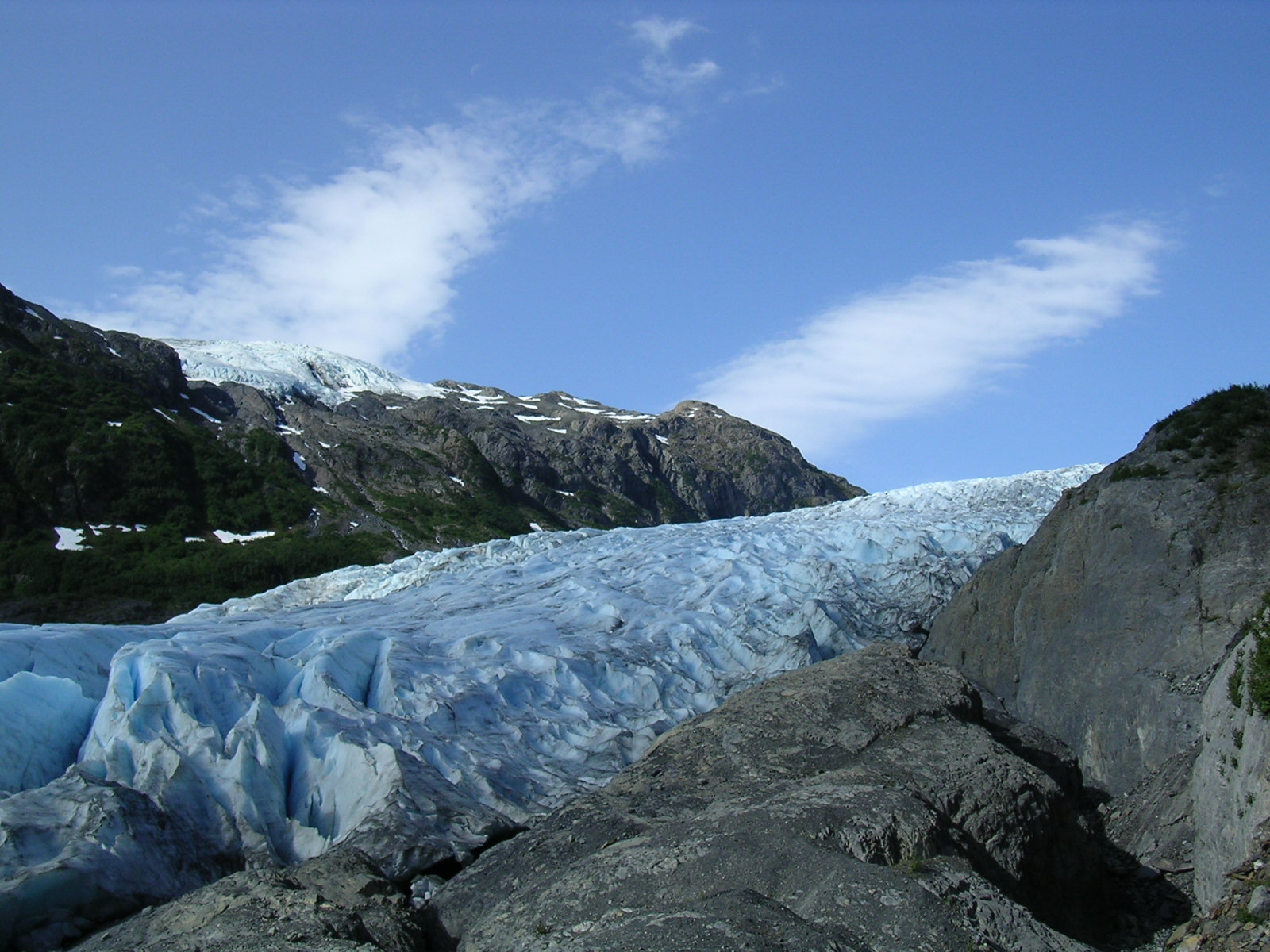
July 9: This would be a weird day. Later in the day we would take the ferry to Homer, with a short stop at Kodiak Island. The ferry would dump us off in Homer at 2 AM.. But first we rode up to see the Exit Glacier. This glacier is 3 miles long and descends some 2,500 feet from the Harding Icefield. We hike up close to it but elected not to hike out on it due to having only bike shoes on. The view was spectacular. We rode back to town for lunch, which was halibut fish and chips (must have picked a bad place as it was not very good, dry and tasteless.)
We headed for the ferry terminal and again got them to let us be the first two onboard. We would spend this night and half on the next night on the ferry, so we put out tents up on the rear deck. Unlike our first ferry this one had no restaurant and we were getting hungry. We did find a microwave and a vending machine. So I had a microwave burrito and a coke (not a very taste meal).
Up ahead of the ferry we could see that we were about to head into a fog bank. With nothing else to do we crawled into our tents for a good night sleep. Just as I was about to drift off the fog horn was turned on. Boy it was loud and sounded like to was right in my tent. Looking out of the tent I found that the fog horn was right above me. I could see that David had move to another location but I still tried to tough it out. The horn blasts were spaced 2 minutes apart, just far enough so that one could almost drift off to sleep. Finally, I also gave up and found a place inside to sleep. But first I had to make sure the tent was tied down as the wind was getting very strong. It was not a good nights sleep and I was very happy to see morning come and that the fog and wind was gone.
July 10: I woke with a sore throat, which did tour into a common cold. The cold would be my “short version,” meaning it only lasted for a few days. Our ferry was the M/V Tusiumena, and after making stops at Port Lions, Kodiak Island and Homer would head out to the Aleutian’s.
When we stopped at Kodiak Island (13,913) we decided to just walk into town and find some real food, we had no breakfast. Now you might not call this real food but it sure taste good, we stopped at McDonalds. We also bought a Subway sandwich to take back on the ferry for our dinner. Back on board the next stop was Homer and we were both very glad to be able to get moving on the bikes again.
Kodiak Island, is known as Alaska’s “Emerald Isle.” It is the largest island in Alaska and the second largest in the United States (after Hawaii), with an area of 3,588 square miles and about 87 miles of road. In 1763, the island was discovered by Stephen Glotov, a Russian explorer. The name Kodiak, of which there are several variations, was first used in English by Captain Cook in 1778. Kodiak was Russian Alaska’s first capital city, until the capital was moved to Sitka (population 8,835) in 1804. In 1900, the decision to move Alaska’s capital to Juneau (population 30,790) was made because of the city’s growth, mining activity and location on the water route to Skagway and the Klondike; the decline of post-Russian Sitka, as whale and fur trading slackened, secured Juneau’s new status as Alaska’s preeminent city.
The ferry pulled into Homer (population 3,946) at 2 AM, right on schedule but it was really to dark to ride to far. The dark was mostly due to the cloud cover. We started to ride in hopes of find a place to stay. But all we found was the famous “Salty Dawg Saloon” which was still open. A lady who was sitting out in front smoking offered to buy us a drink, just what we need. We said thanks but no thanks. I was surprised that the place was still opened, being so late. The bartender told me that last call is at 5 AM. We got back on the bikes and rode on. From the ferry dock to the town of Homer is by way of the “Homer Spit” which is 5 miles long. To our left we could see that looked like camping, but it was on a sandy and rocky beach. At 3 AM we just did not want to mess with putting up the tents. So we found a Boardwalk Shopping area , up on stilts, with shops that we were able to hid behind one of the buildings and tried to get some sleep. We just put our pads and sleeping bags right down on the wooden deck and crawl in. It was another poor nights sleep. By the way the average tide here is 15 feet and a very high tide is 28 feet so I was glad we were high up on the boardwalk.
Homer was established about 1896 and named for Homer Pennock. In the late 1800s, a coal mine was operating at Homer’s Bluff Point (these bluff raise 1,200 feet above the town) and ceased operation around the time of WWII. There are an estimated 400,000,000 tons of coal deposit in the immediate vicinity of Homer.
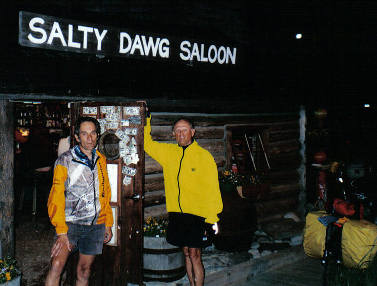
Homer - Great fishing. Stop at the Pratt Museum. Visit the brand new Alaska Islands & Ocean visitor center. Also look for “Jewel” walking the beach (the popular singer, she comes from a longtime Homer family.)
July 11: Half-asleep we rode on towards Ninilchik (population 772) and “The Eagle Watch Hostel” our next overnight. This was one of the best Hostels we stayed in. The rooms were very clean, great showers, but best of all was the view. Also the owners were great. The spectacular view overlooked the Ninilchik River. We were high up on the banks and could look down to the river. Due to this portion of the river being protected form fishing there way many Bald Eagles flying around as well as bears who would come out of the forest to feed on the salmon.
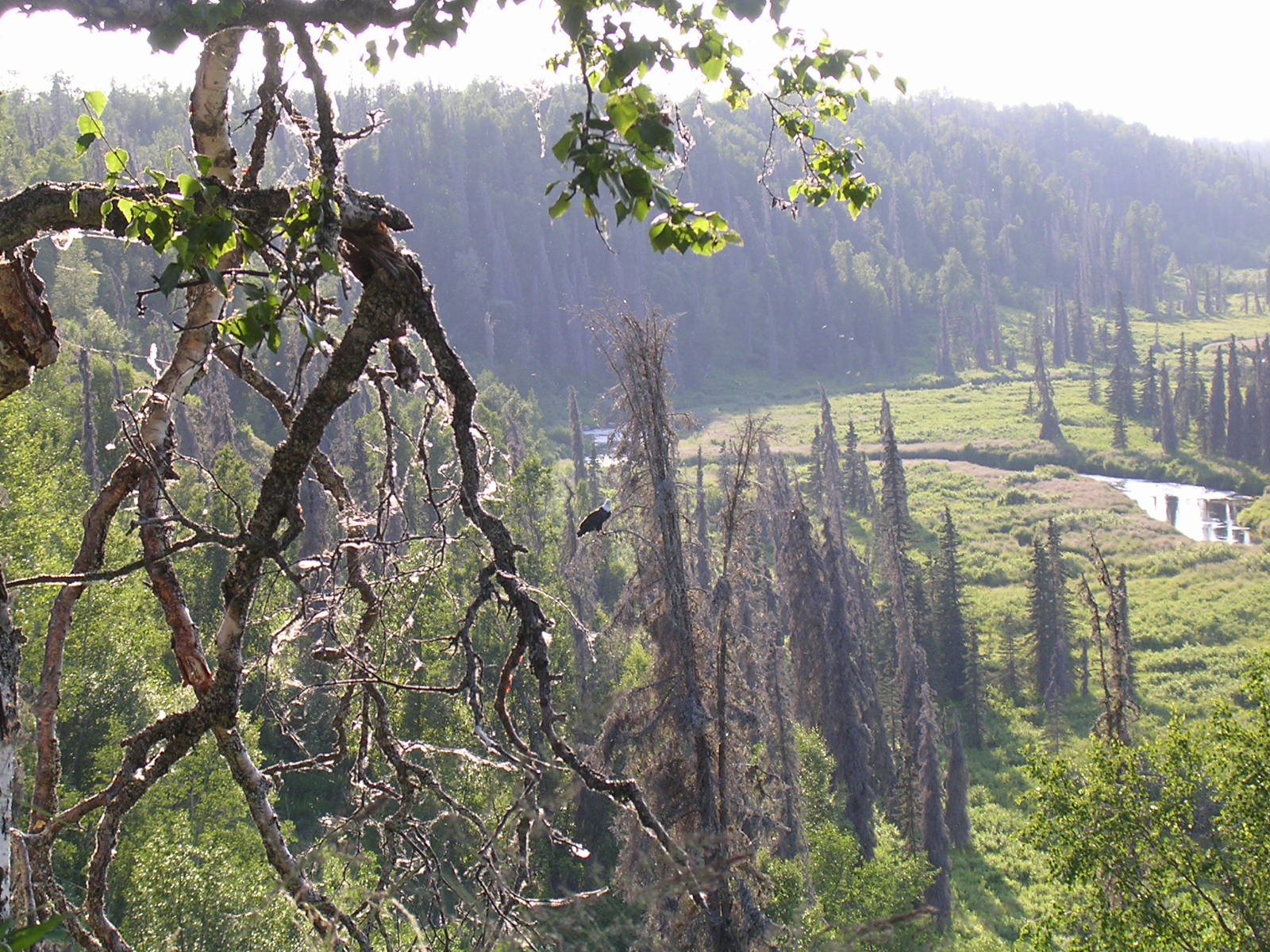
This place is well worth a stay, and not only for the view but the cost was only $10 per night for HI-AYH members ($13 for non-members). While we were sitting around the hostel who should ride in but no other than the guy we met back on June 6 “who was coming from someplace and going to someplace.” This time we found out his names was Paul, but it was still unclear just where he was headed. In the afternoon the owners put a big slab of salmon on the bar-b-q for dinner, their dinner. But they did offer us some, and it was good.
Ninilchik - was settled in the early 1800's by Russian Colonists. They subsisted by hunting, fishing, fur trapping, gardening and panning for gold. The largest trophy halibut caught in Cook Inlet, is a 466-lb. the unofficial world record.
July 12: In the town of Sterling (population 6,138) we found a DQ, first for a longtime and it sure tasted good. Our route today was mostly flat with no shoulder for about 6 miles. I saw “My” second moose, it was right on the side of the road in a marsh area. Since it was kind of hidden and I think I might have been the only one to see it today, So I called it “My” moose.
Without being to critical, I must say that Alaska has to views. One below eye level, which is road construction, lots of glass and rocks on the roadside, unhappy people and signs that threaten to shoot you if you enter. And the other is above eye level which is just gorgeous with great snow capped mountains, tree filled meadows, the bluest lakes, bubbling streams and white glaciers.
This night we would stay at the historic “Gwin’s Lodge,” one of Alaska’s few remaining traditional built log roadhouses. The lodge in the area called “Cooper Landing” (population 285). The lodge was built from Spruce logs in the late 1940's by Alaskan pioneers Pat and Helen Gwin, Gwins was selected by “USA Toady” newspaper as a Top 50 “America’s Best Places” restaurant.
Cooper Landing was named for Joseph Cooper, a miner who discovered gold here in 1894.
Cooper Landing - Catch some fish. Pan for gold. Fly-in for some up close bear viewing. Visit the Cooper Landing Museum. Raft the Kenai River. Ride the Russian River ferry.
July 13: Today we would have another change of transportation, a ride on the Alaska RR. But first he had to get back to Seward and the train station. We started with fog and no shoulder for 7 miles. Since we are now covering some roads that we had ridden on before people are remembering us and others who have passed us, and made a stop, are seeing us for the second time. What I am trying to say people are saying “hello” to us.
Pulling into Seward we had time for lunch, and I took a shower at the Harbor Masters building, for a small fee. Than we rode to the train station just to see how they wanted our bikes packed. We found out that all the do for bikes as well as luggage is to put them in a large plastic containers. Our bikes were put in with the front wheel hanging out. It did not look very good but it did work OK (our bikes arrived safe and sound).
The train ride is one that you should not miss. The scenery was spectacular (the train for the first part of the ride goes through wilderness areas, free of cars and other distractions. Also the train had a very good dining car. I had Bison Chili in a Bread Bowl and a Wild Berry Tart. If you are going to take a train ride I would highly recommend that you take it from Seward to Anchorage or vice-a-versa, rather from Whittier. The best part of the trip is from Seward to Portage.
Arriving in Anchorage we made a mad dash for the hostel, so we could check-in today and not have to wait until tomorrow to check-in, just in case we want to get on the road early tomorrow. We made it. They were expecting us so our beds were reserved.
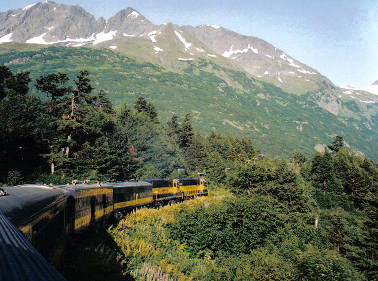
Alaska Railroad - For 80 years the RR has shown passengers the most scenic parts of the Land of the Midnight Sun - some you can only reach by train. Visual gold nuggets such as Hurricane Gulch to the north, and Spencer Glacier to the south. With more than 500 miles track, you’re sure to find a stretch that fits your Alaska dream. The route, including branch lines and sidings, run from tidewater at Whittier and Seward to Anchorage, the largest state’s largest city, and through the heart of Alaska to Fairbanks. Info www.AlaskaRailroad.com
Railroad construction began in 1915 under Pres. Woodrow Wilson. On July 15, 1923, Pres. Warren G. Harding drove the golden spike at Nenana, signifying completion of the railroad.
Tomorrow we head north to Fairbanks.
Kenia Peninsula - Towns of interest - Anchorage, Girdwood, Hope, Whittier, Portage, Seward, Homer, Seldovia, Halibut Cove, Anchor Pint, Nikolaevsk, Kenia and Cooper Landing.