The ride to Anchorage would take us 13 days. After breakfast at “The Corner Café” we were on our way. The weather has been unseasonable hot and will stay that way for awhile. If fact it would not rain until the day before we rode into Anchorage. This first day would be one of the hardest of the whole tour.
For the most part the roads were OK but there sure was a lot of construction that was no fun for bike riders. The construction could be as long as 9 miles, but most stretches where shorter. These road construction stretches were very dusty as the traffic did not slow down.
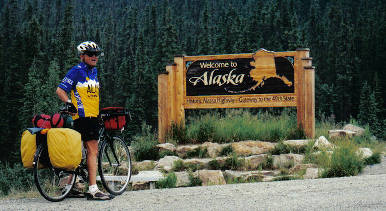
June 22: We climbed from sea-level to 3290 feet in 14 miles. Our excitement was so high we were on top before we knew it. The road follows the famous “Chilkoot Trail”, made famous by the Klondike Gold Rush of 1898. We rode from Alaska through British Columbia and into the Yukon, all in one day. The scenery was beautify, especially once over the top. There was a lot of blue lakes and wonderful mountains. As we passed into Canada the person at the border asked us if we saw the bears. We did not so I guess we just rode right pass them. Three new friends, that we met on the ferry stopped to talk. They were surprised just how far we had already ridden. They gave us a cold drink which was very welcome, as it was getting hot.
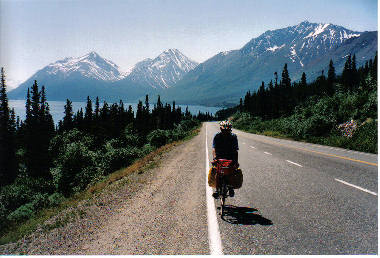
We knew that today there would be no place to buy our lunch so we had a loaf of bread and a jar of peanut butter with us. Stopping for lunch we made a sandwich and it sure tasted good. For most of the tour we would be carrying these items. We each carried some personal snack food with us. Mine was small bags of nuts, gorp (a mixture of nuts and dry fruit) and candy bars (mostly Planters Peanut bars, which do not melt in the heat.)
All to soon we pulled into Carcross (population 400) our over night. The town is just a wide place on the highway, but it did have a campground with showers and a restaurant. If you have read any of our passed tours you will know that the our first order of business was always to get the tents up (just in case of rain.) By the way this would be the only night we had to camp, other than on the ferries.
At dinner I left my red wallet sitting on the red bench next to me (of course I did not know that I had lost it). Later that evening while lying in my tent the lady from the restaurant came by to tell me that they found it and it would be locked up until morning. In the wallet I had about $400 in cash and another $400 in Travelers Checks. I wonder if it all would be there. I could not wait until morning. I am very happy to say every penny was there as well and all my other personal stuff. Since I figured that they would take anything for finding and returning the wallet to me I just left a very nice tip. So if you are in the area stop by the “Montana Best” café
Carcross Desert - There’s a pullout north of town to view the “world’s smallest desert,” sandy hillsides that used to be a glacial lake-bed. Explore the dunes and their fascinating ecology. You’ll spot some unique plants that survive in these arid, windy conditions. Visit the Old Train Depot and be sure that you take the walking tour of the town. Note: in 1904 Bishop Bompas requested Caribou Crossing (the original town name) be renamed Carcross, why is still unclear to me. The original name came from the large number of caribou that traversed the narrows here between Bennett and Nares lakes.
June 23: Another hot day but nice riding for me (I like it hot.) We headed for the big town of Whitehorse (population 22,526). Our overnight was at the “Hide on Jeckell Hostel and Guesthouse” - the street name was Jeckell.) We checked in and then rode around town making a stop at “Icycle Sport” a bike shop. I was looking for a Yukon bike jersey, they had none and told us that they were the only bike shop in the Yukon. Oh well, we did have a Alaska Jerseys. Dinner was at “Boston Pizza” which is just the best pizza.
Whitehorse -Visit the S.S. Klondike, the largest sternwheeler to ply the Yukon River. Stop by the Yukon Beringia Interpretive Centre and the MacBride Museum. A look at the Old Log Church Museum in a must. For an evening of fun go see the “Frantic Follies” vaudeville review. Read the Whitehorse Star.
June 24: Today would be a long day in the saddle, 9 hours 25 minutes, coving 102 miles. As we left town a wild wolf crossed in front of us, it was a great sight to see. Just out of town we met a rider who had left Haines Junction (population 811) at midnight to avoid the heat. There would be no place for food or water for the first 79 miles. It was peanut butter sandwiches for lunch again. Due to the heat and lack of water along the way this was the only day I rationed my water. Boy were we glad to reach a RV park that had a small store. I also had my first flat tire.
The last mile or so into Haines Junction was just the worst ride. The road was torn up, lots of loose gravel, a few good size rocks and worse of all they had just watered the road making it a big mud peddle. Also there was a good amount of traffic (even through you can’t see it in the picture.) All that behind us we found a motel and a place for dinner (hamburger steak, pan fried potatoes and steamed vegs - all very tasty). After dinner we headed into town for a some ice cream.
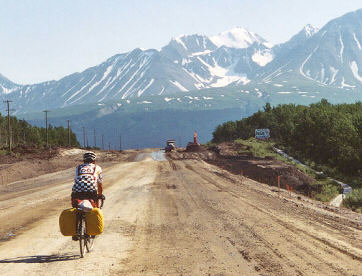
Our original plan was to get off the ferry at Haines but last minute we decided to get off at Skagway. It was a very good decision due to a sign in Haines Junction telling us that there was NO SERVICES between Haines and Haines Junction for 122 miles.
Haines Junction - Singing and Cycling. Three popular events are held each June. The Alsek Music Festival is a celebration of music from the Yukon and the Kluane Mountain Bluegrass Festival. Then hang around for the International Bike Relay where hundreds of teams up to eight members riders race the 148 miles from here to the sea.
June 25: Today we would get our first taste and smell of smoke from the wild fires that covered a lot of Alaska this year. It was one of the worse fire seasons they have had. It was a easy ride as we rode through the Kluane National Park and along the banks of Kluane Lake to Burwash Landing Resort (population 84), our overnight. We had hoped to get a glimpse of Mt. Logan (19545 feet) but never did see it. It may not have even been possible to see it from the road.
After enjoying another peanut butter sandwich on the banks of the Slims River, where it flows into Kluane Lake, we made a stop at Sheep Mountain, hoping to see the sheep high up on the mountain. We did not see any. We met a Dutch Man who was riding to South America.
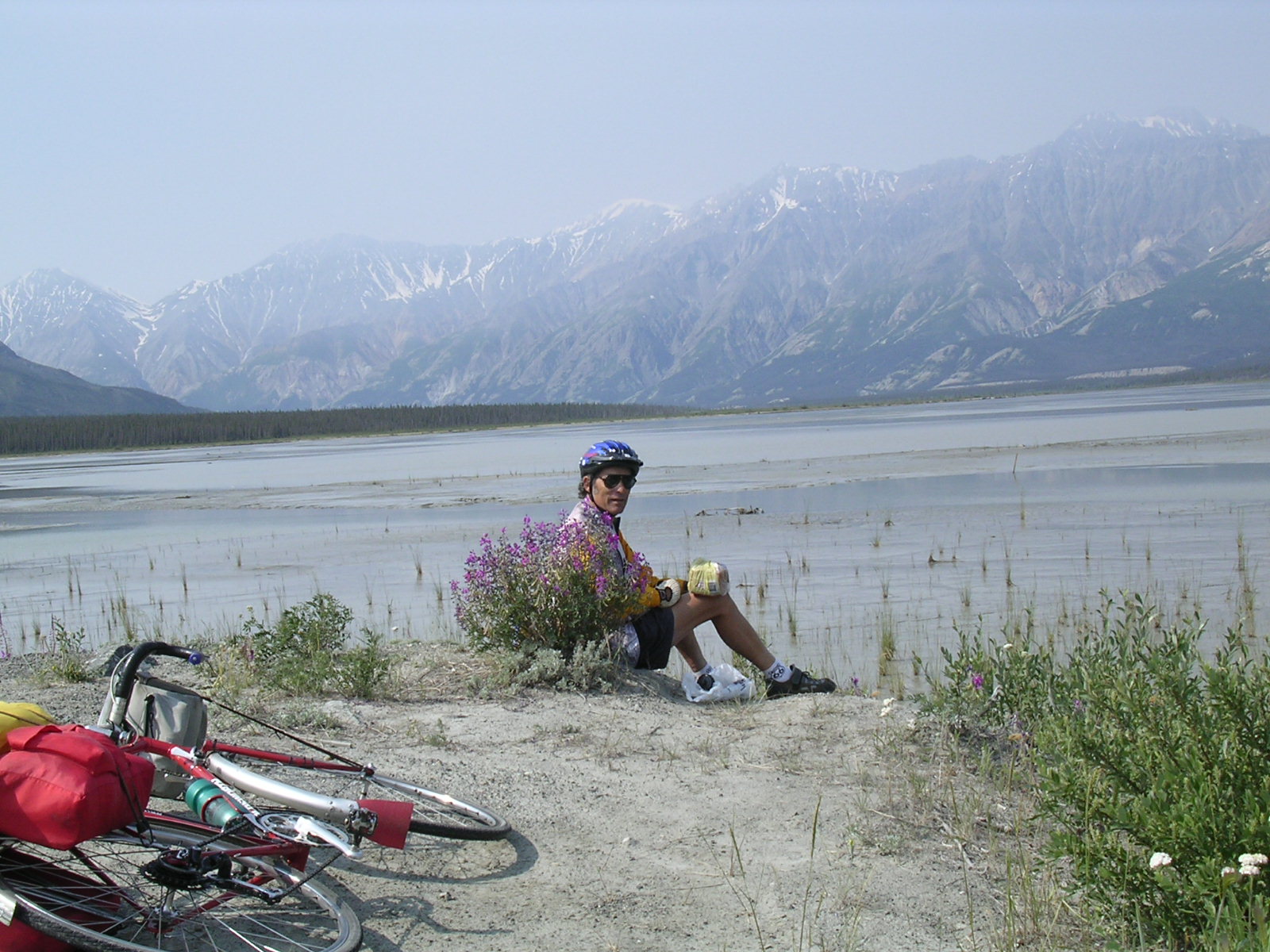
After checking in we rode around a little. There was no place to ride and the road in and out of the resort was a dirt road so we just returned to the resort where I cleaned and oil my bike. There was a very nice restaurant that was part of the resort where we ate dinner.
Today was my birthday so for dessert I had Bumbleberry pie ala-mode. This was my first taste of Bumbleberry and I was not sure just what a Bumbleberry was. Yes, it was very tasty. Today (Dec 7) I finally got around to trying to find out just what a Bumbleberry was. It was not in a dictionary so I went to Google and found many recipes for the pie. Most of the recipes for Bumbleberry pie includes apples, rhubarb, raspberries, and blackberries. One recipe also added strawberries. It seems that Bumbleberry is just a mixture of different kinds of fruits.
Visit Sheep Mountain Visitor Centre on the way to Burwash Landing. Maybe you will see the sheep high up on the mountain.
June 26: Today it really began to get smokey, which made the surrounding mountains disappear. It was a nice ride to Pine Valley where we stayed in our first log cabin. I had my second flat of the tour. There was a TV in the cabin but the channel we got to watch was control by the chef in the Kitchen (which was in another building). What ever station he wanted to watch was the station that we got to watch.
June 27: This was our sixth day in the Yukon, which would also be our last overnight. On our way to the town of Beaver Creek (population 112), a man in a truck stopped and told us that there was a bear about a mile up the road. As we approached the bear we began to make a lot of noise. The bear made a fast exit into the woods and we rode on. As usual we had stretchers of road construction causing a lot of dust along with the smoke. We were always glad to get through these stretchers of road.
Beaver Creek is Canada’s most westerly community. After checking in we explored the town making a stop Beaver Creek Visitor Reception Centre, which was very interesting. While checking out all the brochures we saw one for the “Beaver Creek Rendezvous.” We decided to take it in. You have two choices, $35 for dinner and the show or $15 just for the show. We decided to just take in the show, both are well worth it. We walked over from our motel to the Westmark Inn and found the Dinner Theatre, where the show is put on, paid our money and went in. There were two large groups of travelers, both “RV Tours,” having dinner. As we sat down and a man came over and asked us if we would like a pitcher of lemonade and some strawberry short cake (on the house). Do I need to tell you our answer?
This dinner theatre is Yukon’s best kept secret, a professional cast, joined by the servers present an hour long musical about the pioneers, historical characters and locals who made the Yukon such a special place. The fireplace and the open sky in this spectacular, rustic log roundhouse are the perfect setting for a unique, memorable evening. The show is a three person show, very well done and I highly recommend you attend if you are ever in the area. You will learn the true meaning of the word “potholes.”
June 28: We heard that there were 16 bikers ahead of us. Since they had a sag-wagon, which carries all their gear, they were moving fast and we never did catch up with them. We pulled up to the Yukon/Alaska border with about 4 RV’s in front of us. By the time we reach the check point there must have been 20 RV’s waiting inline (one of the groups that was at the show last night). The officer got I little upset with us, just why was not clear, and told us to get moving.
We are now back in Alaska. Just across the border we made a stop to take off some of our warm cloths. As I looked around I saw two “bong pipes” hidden on the side of the road. Probably hidden so as not to cause any problems while crossing to border. We pulled into the town of Northway (population 351 area) our planned overnight. We found no motel but there was a campground that did not look very inviting. Most of the campgrounds that we found along the way we not set up for tent camping, but more for the RV crowd. Meaning mostly dirt and rocky camping areas. Also there was not place to get a meal in this town. We were told that there was a motel and restaurant seven miles out of town, not the direction we were heading. Since we really had no choice, that is where he headed. After all what is 7 miles (14 total) out of your way when you are on a 3000 mile trip.
The motel and adjoining restaurant were all part of the Northway Airport, a US port of entry for light aircraft. I checked out several rooms before I found one that did not smell of smoke. Even the one I picked did smell, but not as bad as the others. Everyone that worked there or stopped by had a cigarette in their mouth. The water in our room was not very good as it and had a smell and taste of sulfur. We did find that there was good water in the restaurant (it was filtered.)
June 29: As we headed for the town of Tok (population 1,393) the smoke from the nearby fires was getting stronger. One of the main Alaska fires was just 3 miles from the town of Tok (at this time there was 63 fires burning across Alaska). As we approached the turn off to the town of “Chicken” we found the road closed due to the fire. While we had not planned on going to Chicken we did think about a visit, just to say we there. For the next several day were we told that the town of “Chicken was Fried.” But, we did hear later that the town was saved.
The town of Tok was very smokey and dusty. The locals favorite pastime was to ride their ATV’s at high speed on the dirt track the ran parallel to the main highway sending up a clouds of dust. We found a Hostel/B&B; and checked in. The owner, Margie, told us her life story, started back in 1952.
Our original plan was to head for Fairbanks but due to the smoke (we were told it was really bad in Fairbanks) and that David found some small cracks on the rear wheel of his bike we decided to head for Anchorage. David called ahead to be sure they had the rim he wanted, good thing, as they had to order it.
By the way the road signs in the Yukon, that warned us about the bad roads, read “Road Construction” but now that we are in Alaska the signs read “Road Damage” or “Pavement Breaks.” It all meant the same thing “bad roads for bikers.” Tok is known as “Alaska Dog Mushing Capital.”
For breakfast I had my first Reindeer Sausage and Sourdough Pancakes. The sausage was to spicy for me but I would have it again later in this tour and it would be very good. Now for the pancakes there were not very good and when I tried them again they were still not very good. To tough and chewy and did not have a taste that I liked. Both of these items are a standard in Alaska..
Tok - The coldest inhabited community in North America (record low temp = -71 degrees F). The name Tok (rhymes with poke) was long believed to be derived from Tokyo Camp, a road construction camp sprung up in 1943 as part of the straightening and improvement projects on the Alcan Highway. During WWII, Tokyo Camp was patriotically shortened to “Tok.” But, after much research by historian Donna Blasor-Bernhardt is was found that Tok was actually named after a husky pup on August 15, 1942 when the U.S. Army’s Corp was not only assigned to building the road but also naming places along the way. The young pup, named Tok, was their beloved mascot, and upon their arrival at where Tok now is, it was unanimously decided to name the junction after the pup.
June 30: Today we took the Glenn Highway, also known at the Tok Cutoff towards Anchorage. We made a stop for lunch at a small roadside restaurant/motel, Mentasta Lodge, where the owned also had a wood carving shop next door. After lunch I went in the shop to see if he would sell me a mask to put over my nose and mouth as I was getting tired of breathing in the smoke and ash. Without hesitation, he gave me one and would not take a penny for it, thanks. The mask did not stop the smell of smoke it did stop the ash. By the end of the day the mask was notably brown (around the mouth and nose area).
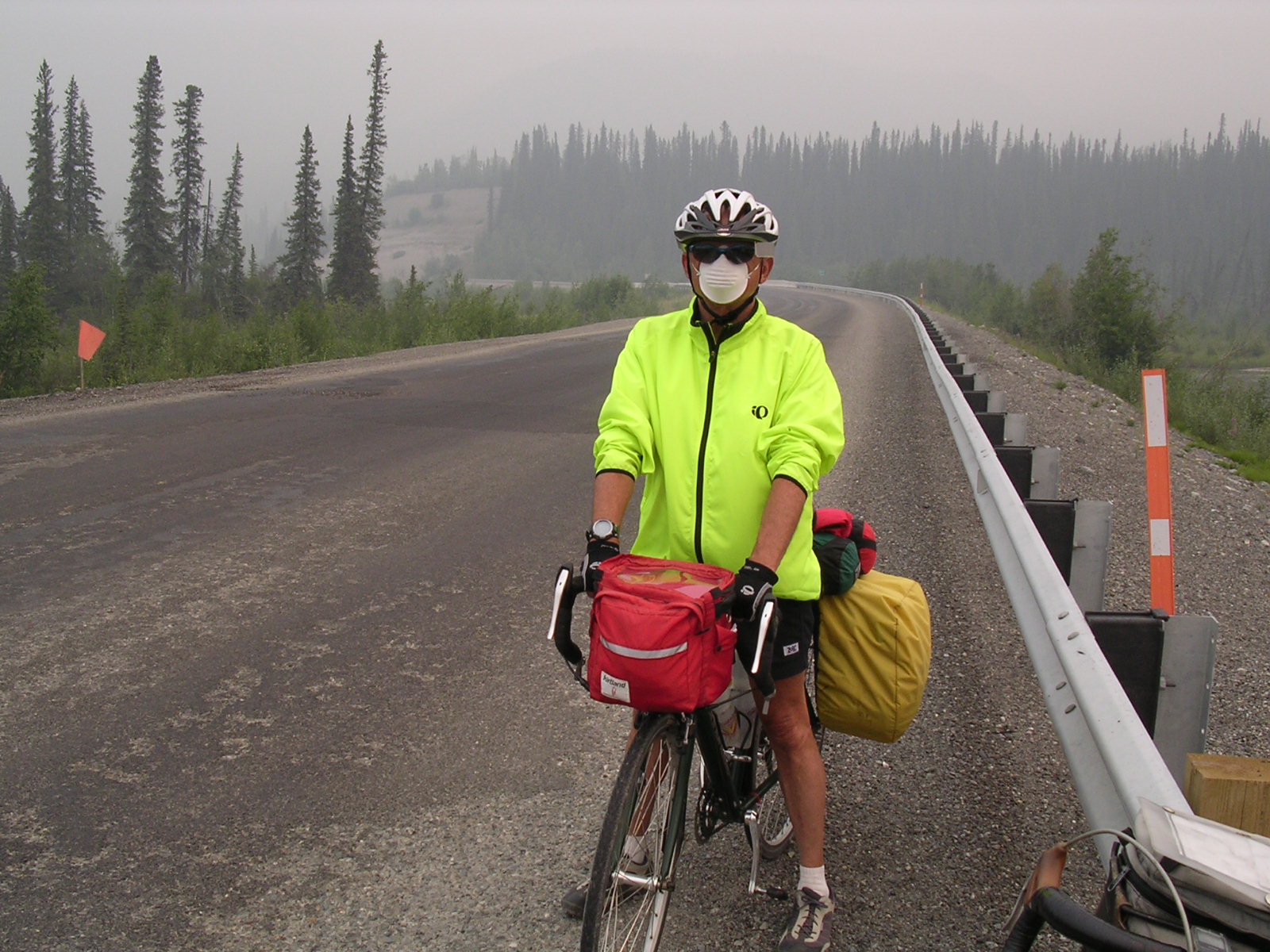
Our overnight plan was to stay in a Hostel near the small town of Slana (population 55) but we could not find it. So we picked a very nice B&B; (Nabesna House). Dinner would be a problem since the B&B; only served breakfast. We asked if we could use their kitchen to cook and we told “sure.” By the way the first place we stopped and checkout (Hart D Ranch) would not let us use their kitchen and was very expensive. They did say we could buy some frozen “stuff” from them and use their microwave. This did not sound very appetizing. We were both glad we moved on to the second place (by the way there was only two places).
We rode backout to the highway where there was a small store (Midway Services) to find fixing for dinner. David decided to cook his famous spaghetti. We found all the ingredients and rode back to the B&B.; We invited the owner, Gary, (who’s wife was on a shopping trip to Anchorage) to join us the dinner. He said he would be happy to do so and would make a salad for all of us.
This area is known as “Copper River Country” famous for it’s Copper River Red Salmon. Gary took us to see his fishwheel which was placed in the near by Copper River. This device works like a water wheel that just scoops up the fish (mostly salmon) and dumps them into a holding tank, still alive. The tank had about 10 good size Copper River Red Salmon in it.
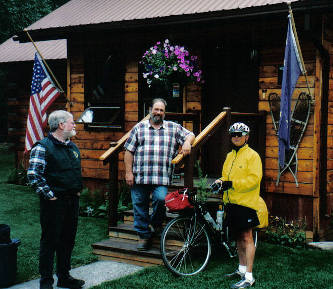
website: www.nabesnahouse.com - email: gmcmichael2002@yahoo.com
David prepared dinner, which was as good as ever and we all sat down to eat. It was a very nice evening of talk and good food. Breakfast, the next morning, was OJ, coffee, eggs, reindeer sausage and blueberry pancakes. This was one of the best overnight of the whole tour and it was great to stay with someone who was so friendly and up-beat. If you are ever in the area this place is a must stop.
Slana - located in the harsh wildness off the isolated Nabesna Road, was the very last place in America to be homesteaded. By 1986, when homesteading finally ended in Alaska, 800 pieces of land had been staked in Slana. But 50 below zero winters, tent homes, and lack of jobs eventually drove off over 70% of Slana’s hardworking, hopeful residents.
July 1: As we headed south toward the town of Glennallen (population 554) the smell of smoke began to decrease. There was still enough smoke in the air to spoil the view of the Wrangell-St. Elias National Park and Preserve. The Wrangell’s include Mt. Sanford which has an elevation of 16,390 feet.
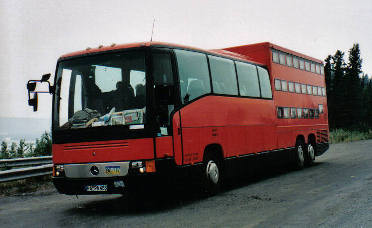
Today was a mostly flat ride with no place to eat. So we enjoyed our favorite peanut butter sandwich. We stopped to talk to a group of German tourists who had brought their own super bus with them. It was a Mercedes bus that had sleeping quarters, a eating place, bathroom in rear and a observation room in the front part. Pretty nice!
Reaching Glennallen we began looking for a place to stay. Our first stop was the Caribou Hotel, which was by far the nicest place in town. Wow, the price was very high so we started to leave and look elsewhere. The clerk stopped us a told us they a less expensive rooms in the Caribou Hotel Annex. What this Annex was is a moved Trans-Alaska Pipeline Camp. When the pipeline was completed many of the housing units were bought and moved to other places. We will end up staying in 5 of these places. They ranged from very nice to just about unlivable. Most had the bathroom and shower down the hall. This one was the worst. When I went to take a shower a guy was showering his “big” dog in the stall next to me. On the good side was that since this one was so bad it made the other look pretty good to us.
Glennallen - the name is derived from the combined last names of Capt. Edwin F. Glenn and Lt. Henry T. Allen, both leaders in the early exploration of the Copper River region. Glennallen is the gateway to the Wrangell Mountains.
July 2: It got cold last night and when we let Glennallen in the morning it was still cold, smoky and fogy. I saw a motorcycle with a side car heading towards us. As it passed I recognized the driver and waved, it was Dave and in the side car was his dog, which he called “Yellow Dog.” Dave hung a “u-turn” and we had a great visit. We met Dave and his Dog on the ferry, which now seemed so long ago. Dave was riding on a old 1930s Harley and was just touring Alaska. It was good to see him and Yellow Dog.
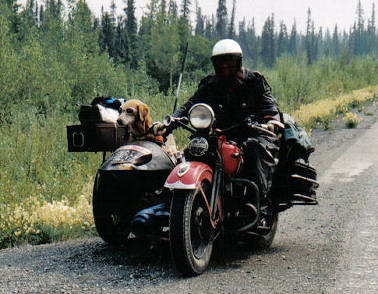
Lunch was at Mendeltna Creek Lodge (population 63), as nice place with good burger’s and coffee. With two long climbs today we also made a stop for a snack in the afternoon. But first we had to climb up to “Eureka Summit (3,322 feet), the highest point on the Glenn Highway. Our snack was at the Eureka Lodge, opened in 1936 and still has $0.25 coffee. Our overnight was at Sheep Mountain Lodge.
This Lodge is also a Hostel. It’s a very nice place with a great restaurant and wonderful views of the mountains. After dinner the rain began, the first rain of the trip. We knew from talking to other cyclist, who were heading in the opposite direction that tomorrow would be a tough day. First there would be 9 miles of construction with 2 miles that we were not allow to ride (a pickup truck would ferry us through) and after that there would be 45 miles of NO SHOULDER with heavy traffic. So we went to bed hoping the rain would stop.
July 3: There was a light rain all night and was still raining when we headed out. I had full water-proof rain gear which I put on before we left. It’s always easier to put on all this stuff when you are inside, dry and be able to take your time. All to soon we reach the muddy construction zone and were required to put our bikes in the back of the small pickup truck. It sure would have been nice to stay in the truck for the whole 9 miles but that did not happen.
At some time on today’s ride I broke a front spoke, which David fixed like new, Thanks. The first broken spoke on any tour and only my second broken spoke in my 35 years of cycling. It was no fun riding through this muddy mess but it was far less fun on the 45 miles of no shoulder. At one point a 18-wheeling, when passing me, bragged his trailer so close to me it ran me off the road. I could see it coming so I was ready. Today was a high stress day. (It is funny that no matter how bad a day might be, by the time you find a place to stay and have a good meal, all that is forgotten - Life is Good.)
Today we met Ralf and Anja (on their honeymoon) who were riding to South America, WOW. The rain stopped after we had lunch at the “King Mountain Lodge,” which was 2:30 PM. We were so glad to arrive in the town of Palmer (population 4,533) and to find a nice place to stay. First order of business was to give our bikes a good cleaning. With clean bikes we headed out to explore the town, had dinner and then turned in for the night. Tomorrow we would arrive in Anchorage on the Fourth of July.
In 1935, Palmer became the site of one of the most unusual experiments in American history: the Matanuska Valley Colony. The Federal Emergency Relief Administration planned an agricultural colony in Alaska to utilize the great agricultural potential in this valley. Social workers picked 203 families, mostly from the northern counties of Michigan, Wisconsin and Minnesota to join the colony. These families were struck by first the dust bowl, then the Great Depression.
Palmer - Visit the Musk Ox Farm and/or the Reindeer Farm. Go swimming in the public 80 foot pool. If you are there in August stop in for the Alaska State Fair.
July 4: We left Palmer with cool temps and some clouds but it was dry. Looking back over our shoulder we could see that Sheep Mountain was still socked-in and it was probably raining. Soon we were on the major highway that takes you into Anchorage (population 269,070). Getting off the highway for a snack we found when we tried to go back on the highway the bikes were not allowed. So we wound our way along back roads until we found a very nice bike-path that takes you into Anchorage.
Arriving on Anchorage we found that there was a Fourth of July parade going on. Also there was some light showers, but nothing to worry about. Finding our Hostel was not easy but as usual David did a great job. The hostel was very nice and we would spend many more nights there as we rode in and out of Anchorage on our various trips. After checking in we went out to explore. While riding the Tony Knowles Coastal Bike Trail I saw my first Bull Moose. Yes, he was big. He was just along side the trail eating and not much caring that we were watching. Anchorage is know for it’s many miles of bike trails, and we rode on everyone. Also the city is know for having about 400 moose running around town. Dinner was at the “Bear Tooth Grill” very good food.
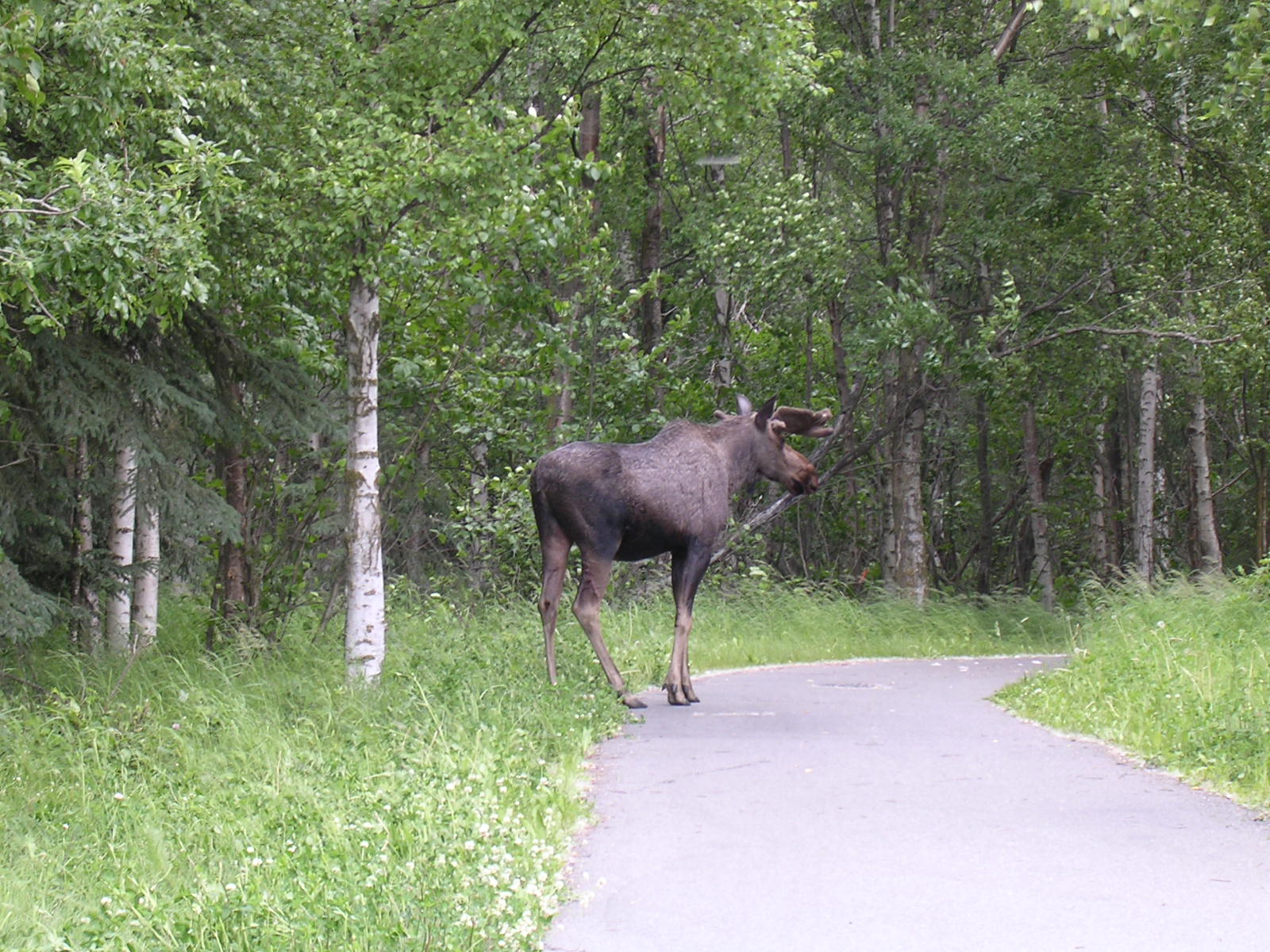
July 5: After breakfast we rode to “The Bicycle Shop” where David had his rear wheel replaced. While he waited for his bike I rode over to Fred Meyers to see if I could find the “Alaska Monopoly” game, for Lois (my wife.) She has quite a collection of Monopoly games. They had none but I would find one later in the tour. We then went for a ride another of Anchorages bike paths. We met a German guy who was riding to Panama (yes, the country.) I will cover more about Anchorage under the link “Home.” Tomorrow we head south for the Kenai Peninsula and away from the smoke.